
myVW AI Virtual Assistant
As the sole designer for the final nine months, I designed Volkswagen’s myVW AI Virtual Assistant, built with AI and machine-learning in a strategic partnership with Google Cloud, to give vehicle owners trusted answers from the Owner’s Manual. I designed the AI chat assistant’s multi-turn search, animated step-by-step guides, and a dashboard light scanner, which launched to 120,000+ owners in September 2024 and expanded to 580,000+ in 2025.
MY RESPONSIBILITIES
UX design, research, interaction design, prototyping, illustrating, testing, project management
PROJECT TYPE
Custom build for iOS/Android apps
DURATION
Aug 2023 - Nov 2024
TEAM
5 Designers, 2 Developers
(Sole designer, Feb–Nov 2024)

01.Background:
Understanding the myVW Ecosystem
The myVW app serves as Volkswagen's digital companion app to monitor and control key vehicle features. It enables users to easily complete tasks, such as:
-
Managing their vehicle and connected services remotely
-
Accessing maintenance and service information
-
Scheduling dealership appointments
-
Viewing vehicle status and receiving alerts
-
Interacting with new support experiences, including the proposed AI Assistant
02. Problem:
Making Vehicle Information Easier to Access
The primary stakeholder goal was to guide users towards using official, trusted VW resources for help. Volkswagen owners often need quick answers for their vehicle, but locating the right information in a VW Owner's Manual with dense language can be time-consuming and discouraging in times of need.
My team and I were challenged to improve this experience by exploring an AI-powered virtual chat assistant within the myVW app to surface the Owner's Manual information in a more approachable and conversational way. How might we make vehicle information easier to access for Volkswagen owners at the moments they need it?
03. Solution:
Streamlining Information to Instill Greater Confidence
Our goal was to help drivers quickly find clear, trusted information and navigate common vehicle tasks with greater confidence by including features such as:
-
Entry point navigation to the AI chat assistant experience and the AI chat assistant experience itself
-
Results page curated by the AI chat assistant
-
Step-by-step guided screen flows for common questions found in the Owner’s Manual
-
Animating illustrations for step-by-step screen flows
-
Ability to scan and decipher dashboard alerts
04. Research & Discovery:
Understanding the Problem
We understood the scope of our problem by performing research and discovery activities, such as product auditing the myVW app and VW Owner's Manual, performing competitive analysis with other vehicle apps, and content reviewing existing VW resources and assets.

myVW App Audit
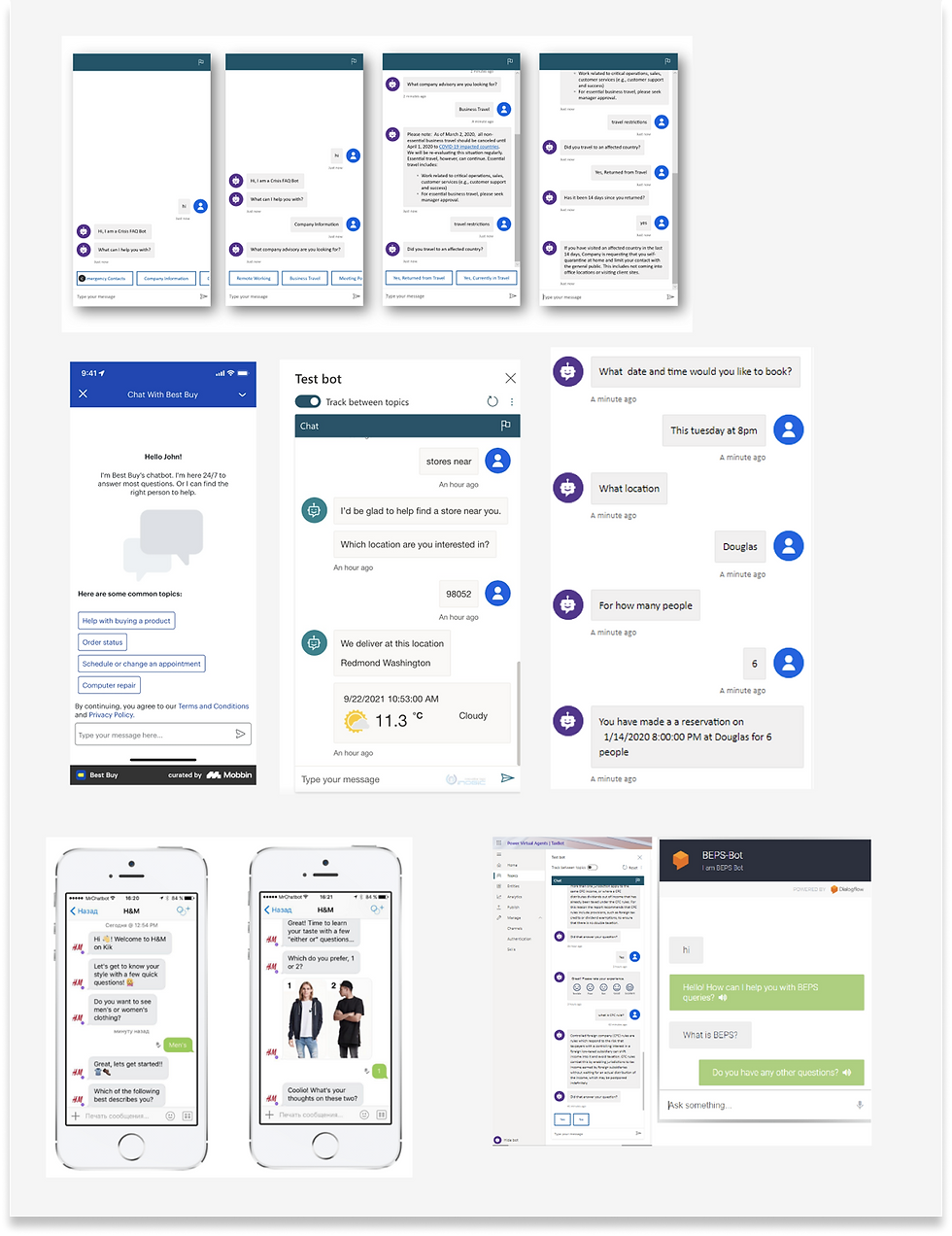
Chatbot Examples (Competitive Analysis)

Owner's Manual Examples (Competitive Analysis)
Understanding Available VW Resources
Through auditing Volkswagen’s resources and support ecosystem, we identified 3 official resource types: Owner’s Manual, VW YouTube Videos, and VW Help Center Articles.
This showed that VW had a strong variety of content, but access to them seemed inconsistent and fragmented when it came time for users to find them.
04. Research & Discovery:
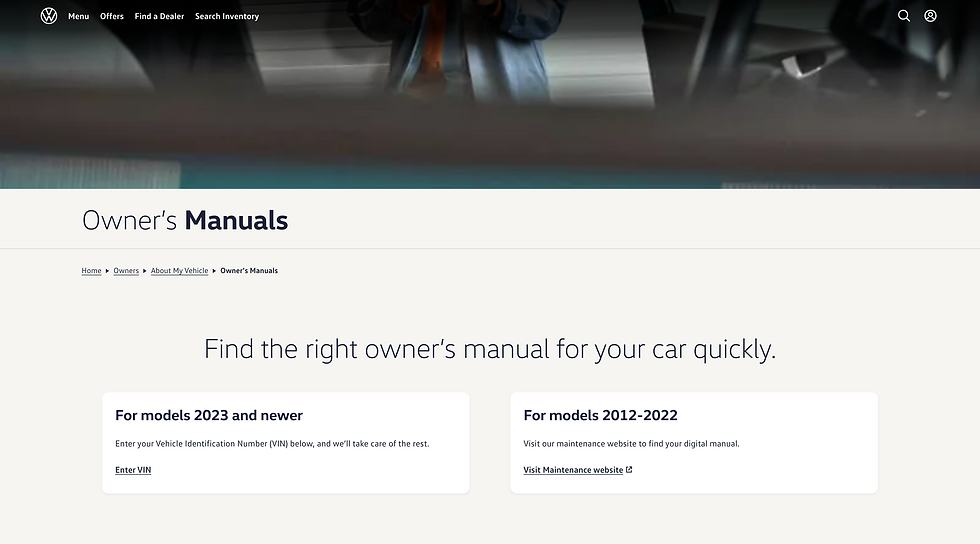
VW Online Owner's Manuals


VW YouTube
VW Help Center
By usability testing initial ideas and strategy, we also found that out of 10 interviewed participants, 80% prioritized utilizing some form of the internet, whether by searching online forums or watching YouTube videos for answers to their vehicle problems. Only 1 participant stated they would reach for a physical manual first.
Key theme: Vehicle owners prioritize highly visible and easy to locate, fast content for answers.
05. Constraints & Considerations:
Aligning with Stakeholders on Constraints
Throughout this design initiative, we also had to consider constraints from stakeholders, such as:
-
Adherence to VW design system and styling
-
AI chat assistant should complement, but not replace the Owner’s Manual, with all responses coming from the Owner’s Manual
-
VW Legal team approval of all language, which should come from trusted VW resources
-
At the time, the myVW app was available for owners of Volkswagen vehicles model-year 2020 or newer. With the provided information from VW, we were directed to focus on the Tiguan (2020-2023) and ID.4 (2021-2023) models of vehicles.
Stakeholders also prioritized:
-
Guiding users towards finding answers using trusted, VW resources
-
Making Owner’s Manual information within the app more user friendly
We determined that our goal was to design a better way for vehicle owners to find all the answers they need within the myVW resource ecosystem. Thus, our design process explored how AI could help surface all official VW resources in one place within the app, which resulted in the myVW Virtual Assistant.

06. Ideation & Iterations:
Ideating on the AI-Assisted Experience
We went through multiple rounds of wireframes for the AI chat assistant’s multi-turn search, the results page, the illustrated step-by-step guides and the dashboard scanner.
Designing for Multi-Turn Search
Working alongside Google’s AI team, I learned how multi-turn search works and designed for it. The AI chat assistant keeps context across follow-up questions instead of treating each one as a new search.
Results Page Evolution
Early wireframes showed a full page of Owner’s Manual results. The next iteration grouped guides, videos and articles into an overlay. The final design leads with one curated top result, with related resources beneath it.

Step-by-Step Guided Flows
We were given six initial Owner’s Manual topics, such as replacing a key fob battery and troubleshooting CarPlay and Android Auto. For each one, we edited the manual’s instructions down to a concise step-by-step flow, mapped branching paths (wired vs. wireless, for example), and estimated how many illustrations it would need.

Dashboard Scanner Flow
Users capture a dashboard light, then confirm it in the AI chat assistant. If the match is right, they get results. If not, the AI chat assistant asks them to rephrase.

Dashboard Scanner User Flow
07. Delivered Product:
Hi-Fidelity Solutions
Powered by Volkswagen's connected car data and Google Cloud's Gemini models on Vertex AI, the new generative AI-powered Virtual Assistant delivers accurate, low-latency responses for customers with questions about their vehicles. It surfaces content not only from the Owner’s Manual, but also from official YouTube videos, Help Center articles, and newly designed step-by-step illustrated guides—consolidating resources that were once fragmented across the ecosystem.
See It in Action
AI Virtual Assistant & Results Page

Tap the assistant icon in the upper right corner.
Ask a question in a conversational way.
Multi-turn search narrows down the question until the assistant can deliver a Results page.
Step-by-Step Illustrated Guide

Choose from the resources on the Results page.
Open the step-by-step guided flow, if one matches the question.
Swipe through the steps for detailed instructions.
Animated illustrations act as visual aids for certain steps.
Dashboard Scanner

Tap the scanner icon in the assistant’s text field.
Acknowledge the safety disclaimer.
Capture the dashboard light with the camera.
Results for the light appear in the assistant.
Dashboard Scanner
Step-by-Step Guides
Results Page
AI Virtual Assistant
Selected Final Screens


Key Design Decisions
-
AI Virtual Assistant: The entry point sits at the top right of every main screen so it’s easy to find, and its magnifying glass with sparkles icon signals searching for answers with AI. A chatbot character was cut to avoid diluting the brand, leaving a cleaner, more minimal assistant.
-
Results Page: Results can come from four sources, including the Owner’s Manual, VW article pages, VW YouTube videos and the step-by-step illustrated guides, so the page adapts to whichever ones match the question.
-
Step-by-Step Guides: The screens were designed so any Owner’s Manual instructions can become a guided flow, with optional pre-steps, animated illustrations, videos and sub-steps, plus an “All Steps” page for easier navigation.
-
Dashboard Scanner: The entry point lives in the assistant’s text field, and a “Safety First” modal confirms users are safe before the camera opens.
Selected Animated Illustrations (for Step-by-Step Guides)


08. Outcomes:
From Concept to Launch
My team and I's work evolved from early explorations with AI into an integrated AI-powered experience within the myVW app’s ecosystem.
In September 2024, this work launched to:
120,000+
vehicle owners at initial launch
580,000+
expansion of coverage to vehicle owners in 2025
This demonstrated how AI could become an extension of the digital ownership experience, opening opportunities for additional vehicle education and support for Volkswagen users.
Significant industry and media attention was also generated from this launch:
-
Featured in Google's Gemini at Work global event alongside Volkswagen and Google Cloud leadership
-
Featured in Volkswagen's official launch communications
-
Covered by Reuters, PR Newswire, and other news outlets
-
Recognized across social channels by Volkswagen and Google Cloud leadership


09. Reflection:
My Takeaways
I worked on this project with my team for 13 months starting in October 2023. Eventually, I was the remaining designer for the project for the last 9 months from February-November 2024, touching every part of the designs. I contributed to the product experience from early exploration through design refinement, heavily focusing on the AI Assistant's entry point and AI Chat Assistant experience, illustrations and animations for the Step-by-Step Guided Flows and the Flows themselves, as well as on updates and iterations for the Dashboard Scanner. I managed client communications and presented updates to VW, as well as worked with our development team to bring this work to life. I learned immensely and gathered insights I will carry with me through to future projects:
01. The best solutions respect the ecosystem they're entering
Designing for an established brand like Volkswagen meant balancing a new technology with an existing product, content system, and brand language. Our work needed to feel like a natural extension of the app, and the strongest concepts weren't necessarily the most novel, but were the ones that felt like they belonged.
02. AI isn't the experience—it's an interaction layer.
This project changed how I think about AI in product design. A conversational interface can help users find information, but it isn't necessarily the best format for every task. For vehicle-related questions, like changing a tire, users benefit from structured, visual guidance alongside the conversational experience. This led us to explore the relationship between conversation, Owner's Manual content, and step-by-step guided flows.
03. Alignment is part of the design process.
Working across Volkswagen, with our design and development team, and other workstreams showed me how important it is to understand dependencies early and reinforced the value of early cross-functional alignment. Earlier alignment could have helped us identify dependencies and constraints so that we could spend less time solving problems and more time pushing the experience forward.